Showing posts with label CJEU judgment. Show all posts

Friday, 20 November 2015

Transmission not accessible to the public "not a communication to the public", rules court

The Court of Justice of the European Union (CJEU) gave its ruling yesterday in Case C‑325/14, SBS Belgium NV v Belgische Vereniging van Auteurs, Componisten en Uitgevers (SABAM), on a reference for a preliminary ruling from the hof van beroep te Brussel (Brussels Court of Appeal, Belgium). The reference was received at the CJEU on 7 July 2014, so this ruling is quite a speedy one -- the sign of a case that the CJEU can handle with the need to break into a judicial sweat.

In short SABAM, a copyright administration society which is no stranger to litigation, represents authors in relation to the grant of permission for third party use of their copyright-protected works and in the collection of the fees for such use. SBS, a Dutch-language commercial broadcasting organisation, makes and markets TV programmes. as a broadcaster SBS runs several private commercial transmitters in Belgium. Its programme schedule includes both programmes which it has produced itself and those it gets from third parties.

SBS broadcasts its programmes exclusively by "direct injection", a two-step process by which programme-carrying signals travel ‘point to point’ via a private line to its distributors such as Belgacom, Telenet and TV Vlaanderen. At that stage, those signals cannot be received by the general public. The distributors then send the signals (encrypted or otherwise) to subscribers who view them on their TV sets, sometimes with the aid of a decoder made available by the distributor. Depending on the distributor, those signals are transmitted by satellite (TV Vlaanderen), cable (Telenet) or xDSL line (Belgacom). 8

Said SABAM, as a broadcasting organisation SBS makes a communication to the public within the meaning of Article 3 of Directive 2001/29 [the InfoSec Directive] by transmitting via the direct injection method. Accordingly SBS needs the authorisation of the copyright holders is required.  No way, said SBS: only distributors and other organisations of the same type make a communication to the relevant public in relation to copyright.

The rechtbank van koophandel te Brussel (Commercial Court, Brussels) allowed SABAM’s application and ordered SBS to pay close to a million euros in copyright fees for 2009. SBS appealed to the referring court, which decided to stay the proceedings and to refer the following question to the Court for a preliminary ruling:
‘Does a broadcasting organisation which transmits its programmes exclusively via the technique of direct injection — that is to say, a two-step process in which it transmits its programme-carrying signals in an encrypted form via satellite, a fibre-optic connection or another means of transmission to distributors (satellite, cable or xDSL-line), without the signals being accessible to the public during, or as a result of, that transmission, and in which the distributors then send the signals to their subscribers so that the latter may view the programmes — make a communication to the public within the meaning of Article 3 of Directive 2001/29?’
Yesterday the Ninth Chamber of the CJEU ruled thus (with the main message in bold):
Article 3(1) of Directive 2001/29 ... must be interpreted as meaning that a broadcasting organisation does not carry out an act of communication to the public, within the meaning of that provision, when it transmits its programme-carrying signals exclusively to signal distributors without those signals being accessible to the public during, and as a result of that transmission, those distributors then sending those signals to their respective subscribers so that they may watch those programmes, unless the intervention of the distributors in question is just a technical means, which it is for the national court to ascertain.
To quote the CJEU's own words:
"21 ... it is apparent from the Court’s case-law that the term ‘public’ refers to an indeterminate number of recipients, potential television viewers, and implies, moreover, a fairly large number of persons (see, to that effect, judgments in SGAE, C‑306/05, EU:C:2006:764, paragraphs 37 and 38, and ITV Broadcasting and Others, C‑607/11, EU:C:2013:147, paragraph 32).

22 However, in a situation such as that before the court in the main proceedings, as is clear from the question referred for a preliminary ruling, the broadcasting organisation in question transmits the programme-carrying signals to specified individual distributors without potential viewers being able to have access to those signals.

23 Consequently, the works transmitted by the broadcasting organisation, such as the organisation in the main proceedings, are communicated not to the ‘public’, within the meaning of Article 3(1) of Directive 2001/29, but to specified individual professionals.

24 Given the cumulative nature, referred to in paragraph 15 of this judgment, of the two criteria for a communication to the public, where the condition that copyrighted [this blogger does hope that this Americanism, inappropriate for works which are automatically protected by copyright without any need for formalities, will not catch on in Europe] works must be communicated to a public is not satisfied, the transmissions made by a broadcasting organisation, such as that in the main proceedings, does not, in principle, come within the definition of ‘communication to the public’, within the meaning of Article 3(1) of Directive 2001/29".
Fellow blogger Eleonora's more detailed analysis of this somewhat sparse 34-paragraph decision can be found on the IPKat here.

Thursday, 12 November 2015

Reprobel and fair compensation: CJEU rules on what the InfoSoc Directive does not allow

The Court of Justice of the European Union (CJEU) gave its ruling this morning in Case C‑572/13, Hewlett-Packard Belgium SPRL v Reprobel SCRL, intervener Epson Europe BV, a request for a preliminary ruling under from the Cour d’appel de Bruxelles (Court of Appeal, Brussels, Belgium). Since Eleonora Rosati is preparing a commentary for the IPKat, readers are referred to that weblog for her thoughts on the ruling once they are published [Eleonora's post is now up and running here]. Below we offer a simple account of the facts, the questions posed and the answers that the CJEU gave to them.

In short, Hewlett-Packard (HP) imported reprographic devices into Belgium for business and household use, including ‘multifunction’ devices, the main function of which was the printing of documents at different speeds depending on the print quality.  Reprobel, a rights management company, collected and distributed sums corresponding to fair compensation under Directive 2001/29, the InfoSoc Directive's reprography exception in Article 5(2).

In August 2004, Reprobel told HP that its sale of ‘multifunction’ printers should entail, in principle, the payment of a levy of EUR 49.20 per printer. Following six years of inconclusive meetings and correspondence, HP sought a declaration that no remuneration was owed for the printers which it had offered for sale or that, if such remuneration was owed, the remuneration which it had already paid corresponded to the fair compensation owed under the Belgian legislation, interpreted in the light of Directive 2001/29. HP also claimed that Reprobel should be ordered to carry out within the year, on pain of a periodic penalty payment of EUR 10 million, a study consistent with that referred to in Article 26 of the Royal Decree of 30 October 1997 concerning the remuneration of authors and publishers for copies made for private or didactic purposes of works fixed on a graphic or similar medium and also concerning the number of printers in dispute and their actual use as copiers of protected works for the purpose of comparing that use with the actual use of all other devices for the reproduction of protected works.

In separate but subequently joined proceedings Reprobel summoned HP and sought an order that HP pay it the provisional sum of EUR 1 towards the remunerative payments which Reprobel considered were owed under the Royal Decree.

In November 2012 the Tribunal de première instance de Bruxelles (Court of First Instance, Brussels) ruled that the Royal Decree was incompatible with European law.  This sparked of appeals by both HP and Reprobel to the Cour d’appel de Bruxelles (Court of Appeal, Brussels). That court decided to stay the proceedings and to refer the following questions to the CJEU for a preliminary ruling:
‘1. Must the term “fair compensation” contained in Article 5(2)(a) and Article 5(2)(b) of Directive 2001/29 be interpreted differently depending on whether the reproduction on paper or a similar medium effected by the use of any kind of photographic technique or by some other process having similar effects is carried out by any user or by a natural person for private use and for ends that are neither directly nor indirectly commercial? If the answer is in the affirmative, on what criteria must that difference of interpretation be based?

2. Must Article 5(2)(a) and Article 5(2)(b) of Directive 2001/29 be interpreted as authorising the Member States to fix the fair compensation payable to rightholders in the form of:
(a) lump-sum remuneration paid by the manufacturer, importer or intra-Community acquirer of devices enabling protected works to be copied, at the time when such devices are put into circulation on national territory, the amount of which is calculated solely by reference to the speed at which the copier is capable of producing a number of copies per minute, without being otherwise linked to any harm suffered by rightholders; and

(b) proportional remuneration, determined solely by means of a unit price multiplied by the number of copies produced, which varies depending on whether or not the person liable for payment has cooperated in the collection of that remuneration, which is payable by natural or legal persons making copies of works or, as the case may be, in lieu of those persons, by those who, for consideration or free of charge, make a reproduction device available to others?

If the reply to this question is in the negative, what are the relevant and consistent criteria that the Member States must apply in order to ensure that, in accordance with European Union law, the compensation may be regarded as fair and that a fair balance is maintained between the persons concerned?
3. Must Article 5(2)(a) and Article 5(2)(b) of Directive 2001/29 be interpreted as authorising the Member States to allocate half of the fair compensation due to rightholders to the publishers of works created by authors, the publishers being under no obligation whatsoever to ensure that the authors benefit, even indirectly, from some of the compensation of which they have been deprived?

4. Must Article 5(2)(a) and Article 5(2)(b) of Directive 2001/29 be interpreted as authorising the Member States to introduce an undifferentiated system for recovering the fair compensation due to rightholders in the form of a lump-sum and an amount for each copy made, which, implicitly but indisputably, covers in part the copying of sheet music and counterfeit reproductions?’
In February 2014 the Cour d’appel de Bruxelles allowed Epson Europe BV - - another manufacturer of multifunctional devices -- to intervene in the dispute in the main proceedings.

Today the CJEU ruled as follows, the bits that refer to national Belgian law being emphsized in bold.:
1. Article 5(2)(a) and Article 5(2)(b) of Directive 2001/29 ...must be interpreted as meaning that, with regard to the phrase ‘fair compensation’ contained in those provisions, it is necessary to draw a distinction according to whether the reproduction on paper or a similar medium effected by the use of any kind of photographic technique or by some other process having similar effects is carried out by any user or by a natural person for private use and for ends that are neither directly nor indirectly commercial.

2. Article 5(2)(a) and Article 5(2)(b) of Directive 2001/29 preclude national legislation, such as that at issue in the main proceedings, which authorises the Member State in question to allocate a part of the fair compensation payable to rightholders to the publishers of works created by authors, those publishers being under no obligation to ensure that the authors benefit, even indirectly, from some of the compensation of which they have been deprived.

3. Article 5(2)(a) and Article 5(2)(b) of Directive 2001/29 preclude, in principle, national legislation, such as that at issue in the main proceedings, which introduces an undifferentiated system for recovering fair compensation which also covers the copying of sheet music, and preclude such legislation which introduces an undifferentiated system for recovering fair compensation which also covers counterfeit reproductions made from unlawful sources.

4. Article 5(2)(a) and Article 5(2)(b) of Directive 2001/29 preclude national legislation, such as that at issue in the main proceedings, which introduces a system that combines, in order to finance the fair compensation payable to rightholders, two forms of remuneration, namely, first, lump-sum remuneration paid prior to the reproduction operation by the manufacturer, importer or intra-Community acquirer of devices enabling protected works to be copied, at the time when such devices are put into circulation on national territory, and, second, proportional remuneration paid after that reproduction operation and determined solely by means of a unit price multiplied by the number of copies produced, which is payable by the natural or legal persons who make those copies, in so far as:

– the lump-sum remuneration paid in advance is calculated solely by reference to the speed at which the device concerned is capable of producing copies;

– the proportional remuneration recovered after the fact varies according to whether or not the person liable for payment has cooperated in the recovery of that remuneration;

– the combined system, taken as a whole, does not include mechanisms, in particular for reimbursement, which allow the complementary application of the criterion of actual harm suffered and the criterion of harm established as a lump sum in respect of different categories of users.
Now it's all up to the Cour d’appel de Bruxelles!

Friday, 6 March 2015

Copydan and fair compensation for multifunctional media: CJEU rules

The Court of Justice of the European Union (CJEU) yesterday ruled in Case C‑463/12 Copydan Båndkopi v Nokia Danmark A/S in the latest in a series of responses to requests for preliminary rulings conernning private copying levies. This ruling, in response to a reference from the Danish Østre Landsret back in October 2012, is a long one; it has however been covered in exemplary fashion on the IPKat weblog by Tom Ohta, here.

The national proceedings involve an action brought by rights-holders' body Copydan Båndkopi against Nokia for payment of a private copying levy in respect of memory cards imported into Denmark. In short, the CJEU considered fair compensation in the context of multifunctional media. It also looked at the distinction between media and components in the application of the private copying levy and the prospect of there being an exemption from payment on the basis that the prejudice to rights-holders might be minimal. The judgment reviews earlier CJEU case law including C-467/08 Padawan , C-521/11 Amazon.com and C-425/12 ACI Adam.

Thursday, 26 February 2015

Loser pays? This might be buyer or seller when it comes to artists' resale royalties says CJEU

Judgment was given today in Case C-41/14 Christie's France SNC v Syndicat national des antiquaires, a reference from the French Cour de Cassation for a preliminary ruling from the Court of Justice of the European Union (CJEU). This was not one of the most taxing copyright-related cases to demand the court's attention and the CJEU was able to dispense with it, from start to finish, in just over 13 months -- an impressive performance if one recalls that, only a few years ago, judgments in intellectual property cases often took twice that length of time.  The case is summarised with exemplary clarity by the Curia press release, reproduced below for your convenience:
The cost of the royalty that has to be paid to the author on any resale of a work of art by an art market professional may be borne, definitively, by the seller or the buyer

Although under EU law the royalty is, in principle, to be paid by the seller, the Member States may specify another person from among the professional persons referred to in Directive 2001/84

The resale right is defined in an EU Directive [Directive 2001/84 on the resale right for the benefit of the author of an original work of art] as the right of the author of an original work of art to receive a royalty based on the sale price obtained for any resale of the work, subsequent to the first transfer of the work. That right applies to all acts of resale involving art market professionals (salesrooms, art galleries and, in general, dealers in works of art) as sellers, buyers or intermediaries.

Christie’s France, the French subsidiary of the multinational firm Christie’s, regularly organises auctions of works of art. A resale royalty is payable in respect of some of those sales. Christie’s France has provided in its general sales conditions that, for certain lots marked in its catalogue, it will collect from the buyer, for and on behalf of the seller, the amount representing the resale royalty.

The Syndicat National des Antiquaires (SNA) takes the view that, in placing the onus of the resale royalty on the buyer, Christie’s France’s general conditions amount to unfair competition. Christie’s France considers that the Directive states without further clarification or restriction that the royalty is payable by the seller and thus does not preclude a contractual arrangement regarding responsibility for the payment of the royalty. Hearing the case, the Cour de cassation (Court of Cassation), France, has asked the Court of Justice whether the seller is always definitively to bear the cost of the resale royalty or whether it is possible to depart from that rule by agreement

In today’s judgment the Court declares that the Member States alone may determine the person liable for the royalty. Although Directive 2001/84 provides that the person by whom the royalty is payable is, in principle, the seller, it none the less allows for a derogation from that rule and thus leaves the Member States at liberty to specify another person from among the professional persons referred to in the Directive who, alone or with the seller, will assume liability for the payment of the royalty. The person who has been designated in that way by national law as the person by whom the royalty is payable may agree with any other person, including the buyer, that that other person will definitively bear, in whole or in part, the cost of the royalty, provided that a contractual arrangement of that kind does not affect the obligations and liability which the person by whom the royalty is payable has towards the author. The Court points out that such a derogation is in keeping with the Directive’s objective of bringing to an end distortions of competition in the art market, since the harmonisation concerned is limited to those domestic provisions which have the most direct impact on the functioning of the internal market. For the purpose of achieving that objective, thus circumscribed, it is necessary to make provision as to the person liable for payment of the royalty and as to the rules for establishing the amount of the royalty. However, such provision is not necessary with regard to the question as to who, definitively, will bear the cost of the royalty.

The Court does not exclude the possibility that such a derogation may to some extent have a distorting effect on the functioning of the internal market. However, such an effect is only indirect since it arises as a result of contractual arrangements that are independent of the payment of the royalty to the author, for which the person by whom the royalty is payable remains liable.
Given that Article 1(4) of the Directive reads
"The royalty shall be payable by the seller. Member States may provide that one of the natural or legal persons ... other than the seller shall alone be liable or shall share liability with the seller for payment of the royalty",
it is difficult to see how even the CJEU was going to persuaded to give a different ruling,

There's also a Katpost from fellow blogger Eleonora here, which you are invited to read if you feel in need of further inspiration.

Friday, 23 January 2015

Online infringement actionable where damage occurs, irrespective of where it was intended to happen, says CJEU

In another preliminary ruling of yesterday's date, the Court of Justice of the European Union (CJEU) had to determine where a copyright owner can bring proceedings for infringement when a third party has made the work available online for viewing and downloading without consent. The decision is Case C‑441/13, Pez Hejduk v EnergieAgentur.NRW GmbH, a request for a preliminary ruling from the Handelsgericht Wien (Austria).

The facts are as follows. Pez Hejduk, a professional photographer of architecture, created photographic works depicting the buildings of the Austrian architect Georg W. Reinberg. As part of a conference organised by EnergieAgentur, Reinberg used Hejduk’s photographs in order to illustrate his buildings, with her permission.  Subsequently EnergieAgentur -- without Hejduk’s consent and without stating that she was the author -- made those photographs available on its website for viewing and downloading. Hejduk sued EnergieAgentur in the Handelsgericht Wien, seeking damages of over 4,000 euro plus permission to publish the judgment at EnergieAgentur's expense.

EnergieAgentur raised an objection that the Handelsgericht Wien lacked international and local jurisdiction, saying that its website was not directed at Austria and that the mere fact that a website may be accessed from Austria is insufficient to confer jurisdiction on that court. The Handelsgericht Wien therefore stayed the proceedings and asked the CJEU:
‘Is Article 5(3) of [Regulation 44/2001 on jurisdiction and the recognition and enforcement of judgments in civil and commercial matters] to be interpreted as meaning that, in a dispute concerning an infringement of rights related to copyright which is alleged to have been committed by keeping a photograph accessible on a website, the website being operated under the top-level domain of a Member State other than that in which the proprietor of the right is domiciled, there is jurisdiction only

– in the Member State in which the alleged perpetrator of the infringement is established; and

– in the Member State(s) to which the website, according to its content, is directed?’
Yesterday the CJEU ruled as follows:
Article 5(3) ... must be interpreted as meaning that, in the event of an allegation of infringement of copyright and rights related to copyright guaranteed by the Member State of the court seised, that court has jurisdiction, on the basis of the place where the damage occurred, to hear an action for damages in respect of an infringement of those rights resulting from the placing of protected photographs online on a website accessible in its territorial jurisdiction. That court has jurisdiction only to rule on the damage caused in the Member State within which the court is situated.
While the jurisdictional side of the ruling has its upside, the notion that the court has jurisdiction only to rule on the damage caused in the Member State within which the court is situated is a pain if it potentially means separate litigation in each of 28 jurisdictions to recoup damages on a country-by-country basis, particularly if the aggregated damage is substantial but the per-country damage is rather less so.

Eleonora's Katpost, pointing out that the Advocate General's Opinion also took the view that damages rulings should not be so limited, can be read here.

Exhaustion of copyright and sale of altered products: CJEU rules in Allposters

The Court of Justice of the European Union ruled yesterday that the consent of a copyright holder does not cover the distribution of an object incorporating his work where that object has been altered after its initial marketing to such an extent that it constitutes a new reproduction of that work. The ruling is in Case C‑419/13, Art & Allposters International BV v Stichting Pictoright, a request for a preliminary ruling from the Hoge Raad der Nederlanden (the Supreme Court in The Netherlands).

The ruling deals with the exhaustion of the distribution right in copyright protected works under InfoSoc Directive 2001/29, Article 4 of which reads like this:
Distribution right

1. Member States shall provide for authors, in respect of the original of their works or of copies thereof, the exclusive right to authorise or prohibit any form of distribution to the public by sale or otherwise.

2. The distribution right shall not be exhausted within the Community in respect of the original or copies of the work, except where the first sale or other transfer of ownership in the Community of that object is made by the rightholder or with his consent.
Significantly, the InfoSoc Directive does not contain a proviso found in European trade mark legislation, notably in Article 7(2) of the Trade Mark Directive 2008/95, that exhaustion shall not apply
where there exist legitimate reasons for the proprietor to oppose further commercialisation of the goods, especially where the condition of the goods is changed or impaired after they have been put on  the market.
The facts of our case, in short, run like this:
Allposters, through its websites, markets posters and other reproductions depicting the works of famous painters, which are covered by the copyright exploited by Pictoright. Among other products, Allposters offers its clients reproductions in the form of posters, framed posters, posters on wood and images on canvases. In order to produce an image on canvas, a synthetic coating (laminate) is first applied [by Allposters] to a paper poster depicting the chosen work [for which the copyright is managed by Pictoright]. Next, the image on the poster is transferred from the paper to a canvas by means of a chemical process. Finally, that canvas is stretched over a wooden frame. The image of the work disappears from the paper backing during the process. 
The Hoge Raad der Nederlanden referred the following questions to the CJEU for a preliminary ruling:
‘(1) Does Article 4 of Directive 2001/29 govern the answer to the question whether the distribution right of the copyright holder may be exercised with regard to the reproduction of a copyright-protected work which has been sold and delivered within the [EEA] by or with the consent of the rightholder in the case where that reproduction had subsequently undergone an alteration in respect of its form and is again brought into circulation in that form?

(2) (a) If the answer to Question 1 is in the affirmative, does the fact that there has been an alteration as referred to in Question 1 have any bearing on the answer to the question whether exhaustion within the terms of Article 4(2) of [Directive 2001/29] is hindered or interrupted?

(b) If the answer to Question 2(a) is in the affirmative, what criteria should then be applied in order to determine whether an alteration exists in respect of the form of the reproduction which hinders or interrupts exhaustion within the terms of Article 4(2) of [Directive 2001/29]?

(c) Do those criteria leave room for the criterion developed in Netherlands national law to the effect that there is no longer any question of exhaustion on the sole ground that the reseller has given the reproductions a different form and has disseminated them among the public in that form (judgment of the Hoge Raad of 19 January 1979 in Poortvliet, NJ 1979/412)?’
Yesterday the CJEU answered this battery of questions with some brevity:
Article 4(2) of Directive 2001/29 ... must be interpreted as meaning that the rule of exhaustion of the distribution right set out in Article 4(2) of Directive 2001/29 does not apply in a situation where a reproduction of a protected work, after having been marketed in the European Union with the copyright holder’s consent, has undergone an alteration of its medium, such as the transfer of that reproduction from a paper poster onto a canvas, and is placed on the market again in its new form.
A rather fuller note on this decision by fellow blogger Eleonora, also summarising the not-yet-in-English Opinion of the Advocate General, can be found on the IPKat here (Eleonora has promised more to come ...).  Meanwhile, this blogger will confine himself to the observations that (i) the CJEU appears to have reached the same conclusion as would have been reached in an action for trade mark infringement, notwithstanding the absence of a specific provision along the lines of Article 7(2) of the Trade Mark Directive and that (ii) the term 'moral rights' appears just once, incidentally, in the ruling, while it seems that this ruling will be of particular use and interest to those seeking to resist the distribution of tangible products on the basis of infringement of the right to object to distortion or mutilation of their original works.

This case, whatever you may think of the decision, is another example of the CJEU's new, speedy approach to dealing with references for rulings from national courts.  The reference was only made in July 2013, so the whole issue has been turned round in 18 months. Only a few years ago it was rare for a ruling in an intellectual property case to be issued within 22 months.

Thursday, 15 January 2015

Ryanair scrapes home in database dust-up

Case C‑30/14Ryanair Ltd v PR Aviation BV is a real quickie.  The request for a preliminary ruling from the Court of Justice of the European Union (CJEU) was only made a year ago, on 17 January 2014, -- and, spared the excitement of Advocate General Bot's Opinion, we already have the CJEU's response.

The facts are straightforward. PR ran a website on which consumers could search through the flight data of low-cost air companies, compare prices and, on payment of commission, book a flight.  It took the data it needed, in order to satisfy consumers' requests, from a dataset linked to the Ryanair website which was also accessible to consumers. So far as Ryanair was concerned, anyone accessing its own website had to accept its general terms and conditions by ticking a box to that effect. These contained the following clauses:
2. Exclusive distribution. This website and the Ryanair call centre are the exclusive distributors of Ryanair services. Ryanair.com is the only website authorised to sell Ryanair flights. Ryanair does not authorise other websites to sell its flights, whether on their own or as part of a package. …

3. Permitted use. You are not permitted to use this website other than for the following, private, non-commercial purposes: (i) viewing this website; (ii) making bookings; (iii) reviewing/changing bookings; (iv) checking arrival/departure information; (v) performing online check-in; (vi) transferring to other websites through links provided on this website; and (vii) making use of other facilities that may be provided on the website. 
The use of automated systems or software to extract data from this website or www.bookryanair.com for commercial purposes, (‘screen scraping’) is prohibited unless the third party has directly concluded a written licence agreement with Ryanair in which permits it access to Ryanair’s price, flight and timetable information for the sole purpose of price comparison.’
Relying on Directive 96/9 (the Database Directive) and the local Dutch database and copyright statutes, Ryanair claimed that PR had infringed its rights relating to its data set and that it had acted contrary to the terms and condition of use of its website which the latter had accepted; Ryanair asked for an injunction and damages.

The Rechtbank Utrecht dismissed Ryanair’s claim in so far as it was based on an infringement of Directive 96/9 and the local Database Law, but allowed it under the copyright law. PR appealed and Ryanair cross-appealed to the Gerechtshof te Amsterdam, which both set aside the judgment of the Rechtbank Utrecht and dismissed Ryanair’s cross appeal.  Ryanair then appealed to the Hoge Raad, which decided to stay the proceedings and to refer the following question to the CJEU for a preliminary ruling:
‘Does the operation of [Directive 96/9] also extend to online databases which are not protected by copyright on the basis of Chapter II of [that directive], and also not by a sui generis right on the basis of Chapter III, in the sense that the freedom to use such databases through the (whether or not analogous) application of Article[s] 6(1) and 8 in conjunction with Article 15 [of Directive 96/9], may not be limited contractually?’
This morning the CJEU ruled as follows:
Directive 96/9 ... must be interpreted as meaning that it is not applicable to a database which is not protected either by copyright or by the sui generis right under that directive, so that Articles 6(1), 8 and 15 of that directive do not preclude the author of such a database from laying down contractual limitations on its use by third parties, without prejudice to the applicable national law.
Does this ruling make sense? It does seem strange that the owner of a non-original database which has no copyright protection has a greater degree of contractual freedom than the owner of a database that enjoys protection under the Directive. However, one might say that the limitations on the rights of the owner of a protected database are a quid pro quo for its being protected in the first place -- not that this would be a logical justification for the outcome.

There's a thoughtful note by fellow blogger Eleonora on the IPKat weblog here, which has already attracted some comments.

Thursday, 11 September 2014

CJEU waves the stick at Ulmer, allows non-consensual digitisation

The Court of Justice of the European Union has now given judgment in Case C-117/13 Technische Universität Darmstadt v Eugen Ulmer KG. As is now customary with major copyright rulings, a swift and flamboyant "breaking news" blogpost from Eleonora has already appeared on the IPKat, here. with the promise of more to follow.  The following is a more prosaic note, based on the Curia press release:
A Member State may authorise libraries to digitise, without the consent of the rightholders, books they hold in their collection so as to make them available at electronic reading points

Member States may, within certain limits and under certain conditions, including the payment of fair compensation to rightholders, permit users to print out on paper or store on a USB stick the books digitised by the library

Pursuant to the Copyright Directive [the InfoSoc Directive, 2001/29], authors have the exclusive right to authorise or to prohibit the reproduction and the communication to the public of their works. However, the directive allows Member States to provide for specific exceptions or limitations to that right. This option exists notably for publically [this erroneous spelling of 'publicly' seems to be gaining ground: can we halt its advance, please?] accessible libraries which, for the purpose of research or private study, make works from their collections available to users by dedicated terminals. In the present case, the Bundesgerichtshof (Federal Court of Justice of Germany) is asking the Court of Justice to clarify the scope of this option, of which Germany has made use.

The Bundesgerichtshof is required to rule on a dispute between the Technical University of Darmstadt (Technische Universität Darmstadt) and a German publishing house, Eugen Ulmer KG. The university library digitised a book published by Eugen Ulmer [The book in question is a textbook by Winfried Schulze entitled Einführung in die neuere Geschichte (Introduction to Modern History)] before making it available on its electronic reading posts. It refused the offer of the publishing house to purchase and use as electronic books (‘e-books’) the textbooks Eugen Ulmer publishes (the book in question among them). Eugen Ulmer is seeking to prevent the university from digitising the book in question and users of the library from being able, via the electronic reading points, to print out the book or store it on a USB stick and/or take those reproductions out of the library.

In its judgment delivered today, the Court holds, first of all, that, even if the rightholder offers to a library the possibility of concluding licencing agreements for the use of his works on appropriate terms, the library may avail itself of the exception provided for in favour of dedicated terminals; otherwise, the library could not realise its core mission or promote the public interest in promoting research and private study.

Next, the Court finds that the directive does not prevent Member States from granting libraries the right to digitise the books from their collections, if it becomes necessary, for the purpose of research or private study, to make those works available to individuals by dedicated terminals. The right of libraries to communicate, by dedicated terminals, the works they hold in their collections would risk being rendered largely meaningless, or indeed ineffective, if they did not have an ancillary right to digitise the works in question [The Court adds that this ancillary right of digitisation does not conflict with the normal exploitation of the work and does not unreasonably prejudice the legitimate interests of the rightholder, given that the German legislation at issue in this case provides that the number of copies of each work available on dedicated terminals must not be greater than that which those libraries have acquired in analogue format].

However, the Court holds that that right of communication which may be held by publicly [phew, that's better!]  accessible libraries cannot permit individuals to print out the works on paper or store them on a USB stick from dedicated terminals. The printing out of a work on paper and its storage on a USB sticks are acts of reproduction, in so far as they aim to create a new copy of the digital copy made available to individuals. Such acts of reproduction are not necessary for communicating the work to users by means of dedicated terminals and are therefore not covered by the right of communication by means of dedicated terminals, particularly since they are made by individuals and not by the library itself.

The Court nevertheless adds that Member States may, within the limits and conditions set by the directive, provide for an exception or limitation to the exclusive right of reproduction of rightholders and thus permit the users of a library to print the works out on paper or store them on a USB stick from dedicated terminals. For that, it is necessary in particular that fair compensation be paid to the rightholders.
This blogger will content himself with one small comment: how strange it is that, at a time when the USB stick is fast becoming a techno-dinosaur as the rush to the Cloud gathers momentum, it still retains a capacity to help shape the ever-evolving clouds of copyright law that hover darkly over the real and/or perceived interests of both traditional and progressive publishers and intermediaries.

Wednesday, 3 September 2014

Parody, Deckmyn and the right to object to discriminatory messages: today's CJEU ruling

Judgment was handed down today by the Court of Justice of the European Union in Case C-201/13 Johan Deckmyn and Vrijheidsfonds VZW v Helena Vandersteen and Others, a keenly-awaited ruling on which our colleague Eleonora was off the mark at the speed of lightning to record the case, and her salient thoughts on it, on the IPKat weblog here. For those in search of something less exciting to read, here's a summary which has been kindly prepared by Curia in the form of this morning's unofficial but sort-of-authoritative media release:
"If a parody conveys a discriminatory message, a person holding rights in the parodied work may demand that that work should not be associated with that message

The only, and essential, characteristics of parody are, on the one hand, to evoke an existing work while being noticeably different from it and, on the other, to constitute an expression of humour or mockery 
The copyright directive [Directive 2001/29 on the harmonisation of certain aspects of copyright and related rights in the information society: the InfoSoc Directive] provides that authors have the exclusive right to authorise the reproduction and communication to the public of their works. Member States may however allow a work to be used, without its author’s consent, for the purpose of caricature, parody or pastiche.

The parodied work
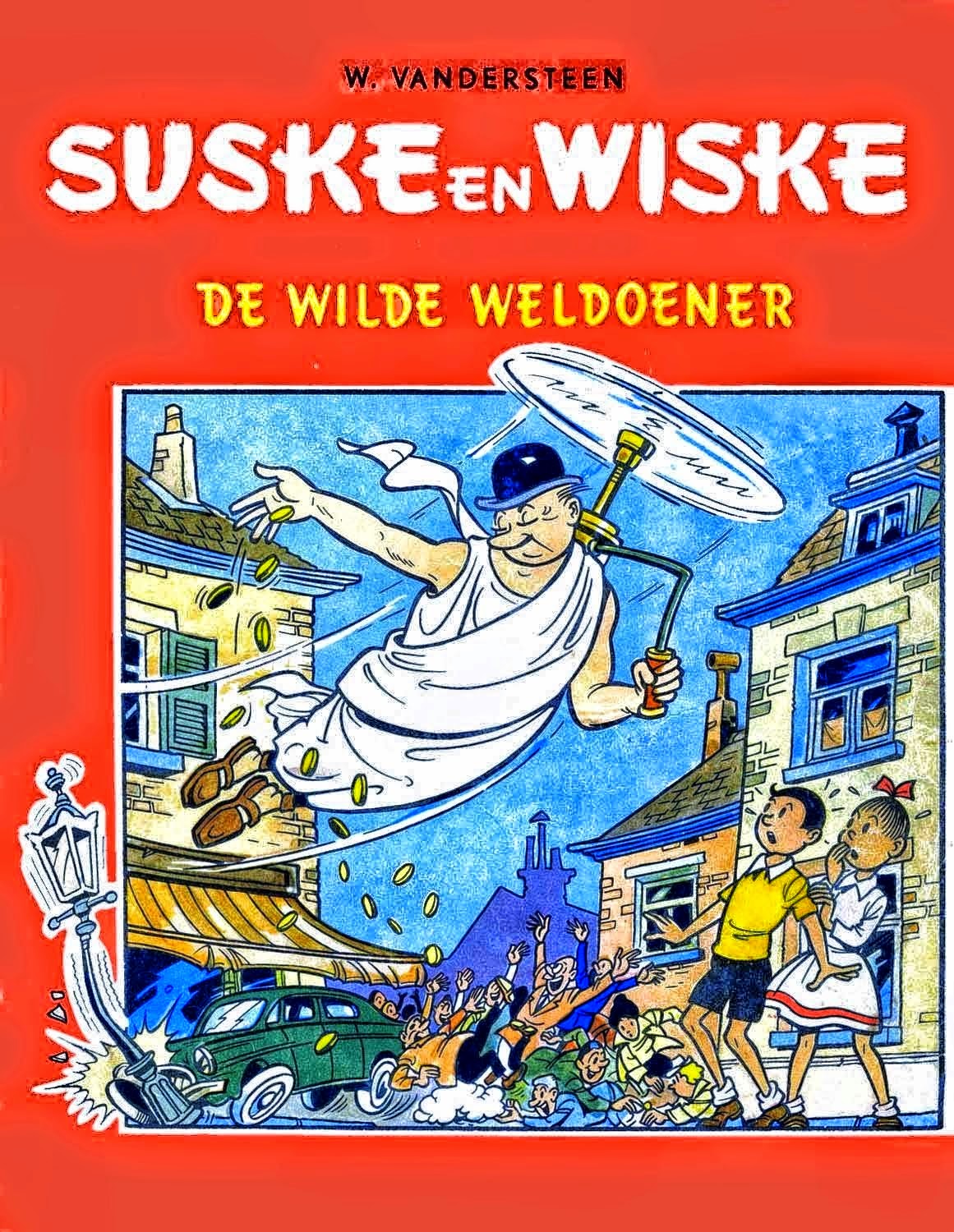
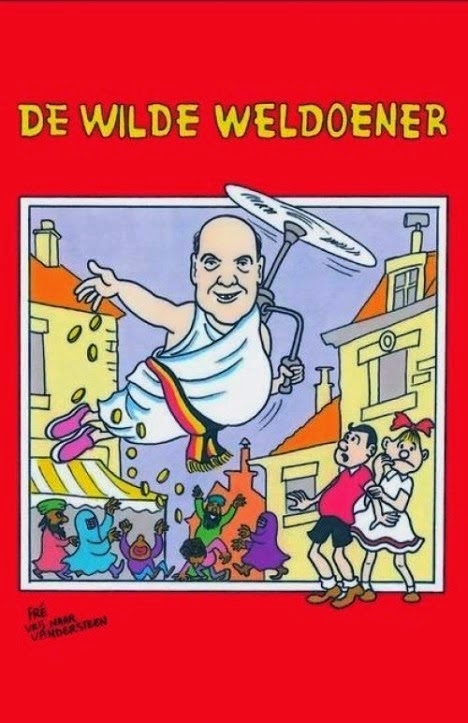
At a reception held by the city of Ghent to celebrate the New Year, Mr Deckmyn, a member of the Vlaams Belang (a Flemish political party), handed out calendars for the year 2011. The cover page of those calendars featured a drawing which resembled that appearing on the cover of one of the Suske en Wiske — known in English as Spike and Suzy — comic books with the original title ‘De Wilde Weldoener’ (which may be rendered as ‘The compulsive benefactor’), produced in 1961 by Willy Vandersteen. The original drawing represented an allegorical character in the series wearing a white tunic and surrounded by people trying to pick to pick up the coins he was scattering all around. In the drawing appearing on Mr Deckmyn’s calendars, that character was replaced by the mayor of the city of Ghent, while the people picking up the coins were replaced by people wearing veils and people of colour.

The alleged parody
Taking the view that the drawing and its communication to the public constituted an infringement of their copyright, several of Mr Vandersteen’s heirs and other holders of the rights to that comic book series brought an action against Mr Deckmyn and the Vrijheidsfonds (an organisation financing the Vlaams Belang). Mr Deckmyn and the Vrijheidsfonds asserted before the Belgian courts that the drawing at issue constituted a political caricature and, therefore, a parody, with the result that the exception established by the directive for that type of work must apply. By contrast, Mr Vandersteen’s heirs and the other rightholders asserted that a parody must itself display originality, which was manifestly not the case here. They also alleged that the drawing in issue conveyed a discriminatory message.

The hof van beroep te Brussel (Court of Appeal, Brussels), hearing the matter on appeal, requested the Court of Justice to clarify the conditions that a work must fulfil in order to be classifiable as parody.

In its judgment delivered today, the Court has noted, in the first place, that ‘parody’ must be defined in accordance with its usual meaning in everyday language [though presumably, since the word appears in a piece of harmonising EU legislation, this everyday language definition is going to have to be consistent across the linguistic and cultural ecosystem of 28 disparate Member States], while account must also be taken of the context in which it is used and of the objectives pursued by the directive. In that regard, the Court notes that, in everyday language, the essential characteristics of parody are, on the one hand, to evoke an existing work while being noticeably different from it and, on the other, to constitute an expression of humour or mockery.

By contrast, a parody need not display an original character of its own, other than that of displaying noticeable differences with respect to the original work parodied [does this need to be spelled out? If the difference between the underlying work and the work parodying it isn't noticeable, it's not going to be much of a parody ...]. In the same way, it is not necessary that it could be attributed to a person other than the author of the original work itself, or that it should relate to the original work itself or mention the source of the work parodied.

In the second place, the Court notes that the application of the exception for parody, established by the directive, must strike a fair balance between, on the one hand, the interests and rights of authors and other rights holders and, on the other, the freedom of expression of the person who wishes to rely on that exception. In that context, the Court declares that, if a parody conveys a discriminatory message (for example, by replacing the original characters with people wearing veils and people of colour), the holders of the rights to the work parodied have, in principle, a legitimate interest in ensuring that their work is not associated with such a message. [the parameters of 'legitimate interest' cry out for explanation and further case law.  Supposing, for example, the underlying work is discriminatory against one sector of society and the parody involves substituting that sector for another sector? Does the fact that the parodied work is itself discriminatory forfeit its legitimacy?]

It is for the Belgian court to determine, having regard to all the circumstances of the case, whether the application of the exception for parody does strike a fair balance between the differing interests of the persons concerned".
One final observation: the practice of placing crucial text in bold print is ever so useful. Can someone encourage the CJEU to do this routinely with Advocate Generals' Opinions and CJEU judgments, not just at the end, in the active part of the ruling, but in the middle too?

Thursday, 10 April 2014

Private copying of unlawful reproductions: CJEU says "no!"

This morning the Court of Justice of the European Union gave judgment in Case C-435/12 ACI Adam BV and Others v Stichting de Thuiskopie, Stichting Onderhandelingen Thuiskopie vergoeding. The judgment is so far available in just five official languages of the European Union, none of which this blogger can handle, so he reproduces the Curia press release for your edification here:
"The amount of the levy payable for making private copies of a protected work may not take unlawful reproductions into account 
The fact that no applicable technological measure to combat the making of unlawful private copies exists is not capable of calling that finding into question

The Copyright Directive [ie Directive 2001/29 on the harmonisation of certain aspects of copyright and related rights in the information society] permits Member States to lay down an exception to the exclusive reproduction right of holders of copyright and related rights so that private copies may be made (the private copying exception). It also provides that Member States which decide to introduce such an exception into their national law are required to provide for the payment of ‘fair compensation’ to copyright holders in order to compensate them adequately for the use of their protected works or other subject-matter.

ACI Adam and Others are importers and/or manufacturers of blank data media such as CDs and CD-Rs. Under Netherlands law, those companies are required to pay a private copying levy to a foundation, Stichting de Thuiskopie. The amount of that levy is determined by another foundation, ‘SONT’.

ACI Adam and Others take the view that, when determining the amount of the levy, SONT should not have taken into account the harm which may be suffered by copyright holders as a result of copies made from unlawful sources.

Against that background, the Hoge Raad der Nederlanden (Supreme Court of the Netherlands) decided to seek a preliminary ruling from the Court of Justice.

In its judgment delivered today, the Court points out that if Member States were free to adopt legislation permitting, inter alia, reproductions for private use to be made from an unlawful source, the result of that would clearly be detrimental to the proper functioning of the internal market [not sure about this: the whole point of copies for private use is, or at any rate was, the fact that each such copy had no impact on the market at all. If this is so, then it's difficult to see how consideration of the liability of an individual for making a private copy of an unauthorised, rather than a lawful, work would affect the functioning of any market, anywhere. Can someone please explain?].

Similarly, the objective of proper support for the dissemination of culture may not be achieved by sacrificing strict protection of copyright or by tolerating illegal forms of distribution of counterfeited or pirated works [but the toleration of the making by an individual of a copy for private purposes is not to be equated with the making or distribution of counterfeit or pirate works by commercial infringers].

Consequently, the Court holds that national legislation which makes no distinction between private copies made from lawful sources and those made from counterfeited or pirated sources cannot be tolerated.

First, to accept that such private reproductions may be made from an unlawful source would encourage the circulation of counterfeited or pirated works, which would inevitably reduce the volume of sales or of lawful transactions relating to the protected works and would consequently have an adverse effect on normal exploitation of those works [Why? The person making money from distributing and selling fakes doesn't isn't going to be more enriched, is he, when someone makes a private copy of "his" work than when it's made of the legimate copyright owner's?]. Secondly, the application of such national legislation may unreasonably prejudice copyright holders.

Furthermore, the Court states that it is for the Member State which has authorised the making of private copies to ensure the proper application thereof and to restrict acts which are not authorised by the rightholders.

National legislation which does not distinguish between lawful and unlawful private reproductions is not capable of ensuring a proper application of the private copying exception. The fact that no applicable technological measure exists to combat the making of unlawful private copies is not capable of calling that finding into question.

Furthermore, the levy system must ensure that a fair balance is maintained between the rights and interests of authors (as the recipients of the fair compensation) and those of users of protected subject-matter.

A private copying levy system, which does not, as regards the calculation of the fair compensation payable to its recipients, distinguish between the lawful or unlawful nature of the source from which a private reproduction has been made, does not respect that fair balance.

Under such a system, the harm caused, and therefore the amount of the fair compensation payable to the recipients, is calculated, according to the Court, on the basis of the criterion of the harm caused to authors both by private reproductions which are made from a lawful source and by reproductions made from an unlawful source. The sum thus calculated is then, ultimately, passed on in the price paid by users of protected subject-matter at the time when equipment, devices and media which make it possible to create private copies are made available to them.

Thus, all users are indirectly penalised since they necessarily contribute towards the compensation payable for the harm caused by private reproductions made from an unlawful source. Users consequently find themselves required to bear an additional, non-negligible cost in order to be able to make private copies".
There seems to be an awful lot of assertion here; this blogger looks forward to reading the full judgment in order to find out how much of it is based on anything more substantial.

Eleonora has posted a "breaking news" item on the IPKat blog here, but promises more to come once she has digested the ruling in full. We await her further thoughts with excitement.

Thursday, 6 February 2014

Another CJEU IP Decision on customs seizures


This morning the CJEU (second chamber) handed down judgement in case C-98/13, Martin Blomqvist v Rolex SA,
Manufacture des Montres Rolex SA

The point at issue before the CJEU (set out in a series of questions which the court condensed to a single answer) was that, in the scenario where somebody purchased from a non-EU website counterfeit goods (in this case, a fake Rolex), could these be seized by customs, it being apparently common ground that the Customs Regulation required there to be an infringement of IP in the EU/in the Member State concerned.

At heart, the referring court was concerned as to whether, in the factual scenario described above, which one might describe as a private importation by an individual, there was any distribution to the public, within the meaning of the copyright directive, and any use in the course of trade, within the meaning of the trade mark directive and the trade mark regulation.

The CJEU seemed largely untroubled by such concerns, reaching the conclusion that: 

Council Regulation (EC) No 1383/2003 of 22 July 2003 concerning customs action against goods suspected of infringing certain intellectual property rights and the measures to be taken against goods found to have infringed such rights must be interpreted as meaning that the holder of an intellectual property right over goods sold to a person residing in the territory of a Member State through an online sales website in a non-member country enjoys the protection afforded to that holder by that regulation at the time when those goods enter the territory of that Member State merely by virtue of the acquisition of those goods. It is not necessary, in addition, for the goods at issue to have been the subject, prior to the sale, of an offer for sale or advertising targeting consumers of that State.

The Court relied on the earlier Phillips case which the IPKat looked at - not with an entirely happy face - here.

Wednesday, 25 December 2013

CJEU takes foot off the GasPedaal, then puts the boot in

Case C‑202/12, Innoweb BV v Wegener ICT Media BV, Wegener Mediaventions BV, is a ruling from the Fifth Chamber of the Court of Justice of the European Union (CJEU) last Thursday, 19 December, following a request for a preliminary ruling by the Gerechtshof te ‘s‑Gravenhage (The Hague Regional Court, The Netherlands). This case has been noted on the IPKat weblog here; a media release has also been received from Joris van Manen (a partner in the Amsterdam office of law firm Hoyng Monegier, which acted for AutoTrack in these proceedings). According to Joris:
"In a landmark ruling, Europe’s highest court:, the CJEU, banned so called 'dedicated meta search engines'.

Gaspedaal.nl [this appears to be the Dutch word for 'accelerator'], a venture of Dutch publisher De Telegraaf, is a dedicated meta search engine that searches through used car advertisements on a number of different Dutch used car websites such as AutoTrack.nl, AutoTrader.nl and AutoScout24.nl. If the Gaspedaal user searches for a particular type of car GasPedaal translates the query into the format of the search engine of these websites. GasPedaal then retrieves data directly, i.e. in "real time", from these websites and displays the combined search results in its own layout to the user. Every day GasPedaal carries out approximately 100,000 searches on the AutoTrack website in response to queries.

AutoTrack, a venture of Dutch/Belgian publisher De Persgroep, filed a lawsuit in 2008 before the District Court of The Hague. The Court banned the "scraping" of AutoTrack because GasPedaal infringed the database rights of AutoTrack. De Telegraaf appealed the judgment and the Hague Court of Appeal referred nine "questions of interpretation" to the Court of Justice in Luxembourg.

In its judgment the CJEU held that GasPedaal’s dedicated meta search infringes Wegener’s database rights as it deprives AutoTrack of its revenues. The court ruled:
“As the end user no longer has any need to proceed via the database site’s homepage and search form, it is possible that the maker of that database will generate less income from the advertising displayed on that homepage or on the search form, especially to the extent that it might seem more profitable for operators wishing to place advertisements online to do so on the website of the dedicated meta search engine, rather than on one of the database sites covered by that meta engine.

As regards, furthermore, database sites displaying advertising, sellers – aware that, with the dedicated meta search engine, searches will be made simultaneously in several databases and duplications displayed – may start placing their advertisements on only one database site at a time, so that the database sites would become less extensive and therefore less attractive.”
According to the court, this practice “comes close to the manufacture of a parasitical competing product.” Thus GasPedaal “re-utilizes” the whole or a substantial part of AutoTrack’s database and hence infringes AutoTrack’s database rights.

The case will now return to the Hague Court of Appeal, which is expected to render its final judgment at some point in the summer.

Van Manen comments: 
"This ruling of the highest EU court is of the utmost importance for the digital publishing industry. It is a strong incentive to develop quality data products without having to fear that these products will immediately be parasited. It again is an important step in the maturation of the internet”.
The ruling of the CJEU is actually quite detailed and fact-specific, so anyone seeking to venture into the attractive territory of meta search should check the judgment out carefully before deciding to give up.

This ruling also illuminates something of greater importance than the decision itself.  According to this media release, the initial action to restrain Innoweb was commenced in 2008.  The dispute has so far gone only as far as trials before a first instance court and an appellate chamber, followed by a reference to the CJEU for a preliminary ruling.  Now it must go back to the Hague Court of Appeal, with the prospect of the decision of that court itself being subject to a further appeal.

It seems to this blogger that, in the digital age, it is absolutely intolerable and unacceptable that a dispute over any aspect of digital communications and internet use should be allowed to take so long.  If some sort of fast-track, rapid response service from the CJEU is not to be made available, the very fact that a reference for a preliminary ruling will delay national proceedings by two to three years becomes a potent weapon in the hands of trial lawyers and also offers a bonus prize for those who make the effort to conjure up the most obscure and remote uncertainties of EU law in order to earn for their clients a valuable lacuna in the litigation process.

Thursday, 3 October 2013

No Small matter: CJEU lays down jurisdiction guidance in Pinckney case

The Court of Justice of the European Union gave its ruling today in Case C‑170/12, Peter Pinckney v KDG Mediatech AG, a reference for a preliminary ruling from the French Cour de Cassation. Since Eleonora has already elaborated on this ruling elsewhere, this blogger will confine himself to reproducing the Curia press release, with a comment or two.
A court within whose jurisdiction a CD offered online is accessible may adjudicate on the infringement of a copyright protected in the Member State within which it is situated [It might seem strange if this were not the case ...]

Its jurisdiction is, however, limited to the damage caused in that Member State [This may be a triumph for territoriality, but it will be rather a disappointment to those who wonde if a plaintiff has to trot off to court in every country in which damage from a single act of offering a CD online may have occurred]

According to the regulation on jurisdiction in civil and commercial matters [Council Regulation (EC) No 44/2001 of 22 December 2000 on jurisdiction and the recognition and enforcement of judgments in civil and commercial matters], the courts with jurisdiction to hear a dispute are, in principle, the courts for the place in which the defendant is domiciled. However, in certain cases, the defendant may exceptionally be sued in another Member State. Thus, in matters relating to tort, delict and quasi-delict, a dispute may be brought, inter alia, before the courts of the place where the alleged harmful event occurred. In a case referred by the Cour de cassation ... (France), the Court of Justice gave a ruling today on whether, in the light of that rule of jurisdiction, the author of a protected work may bring a claim for damages before the courts for the place where he is domiciled for harm resulting from an unauthorised online offer of reproductions of his work.

Mr Pinckney, who resides in Toulouse (France), claims to be the author, composer and performer of 12 songs recorded by the group Aubrey Small on a vinyl record. He discovered that his songs had been reproduced without his authority onto a compact disc pressed in Austria by a company established in that Member State and subsequently marketed by United Kingdom companies through various internet sites accessible from Mr Pinckney’s home in Toulouse. Mr Pinckney therefore sued the Austrian company before the Tribunal de grande instance de Toulouse (Regional Court, Toulouse) for damages for the harm suffered as a result of the alleged infringement of his copyright. Since the Austrian company challenged the jurisdiction of the French courts, the dispute was brought, at last instance, before the Cour de cassation (Court of Cassation). The latter asked the Court of Justice to examine whether, in such circumstances, it must be held that the harmful event occurs in the Member State where the author is domiciled so that the courts of that State have jurisdiction.

In its judgment today, the Court notes that, in cases of infringements committed via the internet which may produce their results in various places, the place where the harmful event occurs may vary according to the nature of the right allegedly infringed. Although the harmful event may occur in a specific Member State only if the right allegedly infringed is protected there, the identification of the place where the harmful event occurred depends, in any event, on which court is best placed to determine whether the allegation of infringement is well founded. However, it is not a requirement for the activity giving rise to the harm to be directed to the Member State in which the court seised is situated [trade mark lawyers may wish to make note of this, since it appears to be widely accepted that a website has to be directed towards a country in which infringement is alleged before infringement can be said to have occurred or a reputation to have been created through use].

The Court of Justice states that the courts of the Member State which protects the copyright relied on by the author and in which the alleged harmful event may occur are the courts which have jurisdiction to adjudicate on an alleged copyright infringement. That likelihood may arise, in particular, from the possibility of obtaining a reproduction of the work to which the rights relied on by the plaintiff attach through an internet site accessible within the jurisdiction of the court seised. However, since the protection granted by the Member State in which the court seised is situated applies only within that Member State, the court seised has jurisdiction to adjudicate solely with respect to the harm caused in that Member State.

Thursday, 4 July 2013

Fair compensation for private copying effected through more than one device

Last Thursday the Court of Justice of the European Union (CJEU) gave judgment in Joined Cases C-457/11 to C-460/11 Verwertungsgesellschaft Wort (VG Wort) v Kyocera, Epson Deutschland GmbH, Xerox GmbH, Canon Deutschland GmbH and Fujitsu Technology Solutions GmbH, Hewlett-Packard GmbH v VG Wort. Further comment and analysis will be forthcoming, but in the meantime we take the liberty of posting the content of a very helpful press release from Curia, which reads as follows:
The levy for the reproduction of protected works can be imposed on the sale of a printer or a computer

Member States enjoy a broad discretion to determine who must pay that levy, the purpose of which is to compensate authors for the reproduction of their work without their authorisation

According to EU law [that's Directive 2001/29/EC of the European Parliament and of the Council of 22 May 2001 on the harmonisation of certain aspects of copyright and related rights in the information society (OJ 2001 L 167, p. 10)], Member States should grant, in principle, to authors and the holders of related rights, the exclusive right to authorise or prohibit reproduction of their protected works or other subject matter. However, Member States may provide for exceptions or limitations to that exclusive right. Accordingly, they may permit, in particular (i) the making of private copies and (ii) reproductions on paper or any similar medium, using any kind of photographic technique or by some other process having similar effects. A Member State which avails itself of this option must, however, provide that the copyright holders receive ‘fair compensation’ ['Fair compensation' is a difficult and elusive topic which this blog has frequently had cause to address: see posts here]. That compensation is to compensate authors for the reproduction, without their authorisation, of their protected works. 
The Bundesgerichtshof (Federal Court of Justice, Germany) is called on to give judgment in proceedings concerning the fair compensation owed for the reproduction of protected works made with the use of a chain of devices, including, in particular, a printer and a personal computer, principally where the two are linked together. In those proceedings, VG Wort, the authorised copyright collecting society representing authors and publishers of literary works in Germany, requests that Canon, Epson, Fujitsu, Hewlett-Packard, Kyocera and Xerox be ordered to provide information to it on the nature and quantity of printers that they have sold since 2001. In addition, VG Wort claims that Kyocera, Epson and Xerox should be ordered to pay it remuneration by way of a levy on personal computers, printers and/or plotters marketed in Germany between 2001 and 2007. In those circumstances, the Bundesgerichtshof has requested the Court of Justice to provide it with an interpretation of the relevant provisions of EU law.

In today’s judgment, the Court of Justice, in response, states that the concept of ‘reproductions on paper or any similar medium, effected by the use of any kind of photographic technique or by some other process having similar effects’ includes reproductions made using a printer or a personal computer where the two are linked together [Indeed, it would be difficult to imagine how the court could state otherwise]. In this case, it is open to the Member States to put in place a system according to which the fair compensation is paid by the persons in possession of a device contributing, in a non-autonomous manner, to that single reproduction process of the protected work or other subject-matter on the given medium in so far as those persons have the possibility to pass on the cost of the levy to their customers, provided that the overall amount of fair compensation owed as recompense for the harm suffered by the author at the end of that single process must not be substantially different from the fixed amount owed for the reproduction obtained through the use of one single device [so the compensation depends on the fact of the copying, not the number of devices by which it is effected].

Moreover, the Court finds that an act by which a rightholder may have authorised reproduction of his protected work or other subject-matter has no bearing on the fair compensation owed. The Court states that, in addition, the non-application of the technological measures designed to prevent or restrict unauthorised reproduction cannot have the effect that no fair compensation is due for private copying. The application, by the rightholders, of such measures is voluntary. Nevertheless, it is open to the Member State concerned to make the actual level of compensation owed to rightholders dependent on whether or not such technological measures are applied, so that those rightholders are encouraged to make use of them and thereby voluntarily contribute to the proper application of the private copying exception [But should this mean that compensation is higher or lower when technological measures are used? Arguments can be constructed in favour of both propositions].

Lastly, the Court holds that the relevant legislation ‒ a directive which came into force on 22 June 2001 and which the Member States had to transpose into national law by 22 December 2002 at the latest ‒ does not apply to the acts of using protected works or other subject-matter which took place before that date.
Watch this space for further comments.

Wednesday, 14 November 2012

Does Oracle ruling breach WIPO Copyright Treaty?

Case C-128/11 Oracle v UsedSoft has attracted a good deal of attention and analysis from within Europe, much of it sharply critical -- but it has also been noted by both academics and practitioners from further afield. One such distant source is a respected and seasoned New Zealand lawyer, Ken Moon (AJ Park Law), who has expressed himself as being troubled by it.  His perspective on the case is reproduced here:
"Europe in breach of international copyright treaty 
A recent decision of the European Court of Justice (CJEU) on the licensing model for software transactions, has inadvertently breached the WIPO Copyright Treaty of 1996. There are numerous international treaties governing copyright law, but the treaty which brought copyright law up to date with the internet was the 1996 World Intellectual Property Organisation (WIPO) Copyright Treaty (WCT).

It now appears that a decision from the European Union's highest court, the CJEU, means that the countries of Europe, despite ratifying the WCT in 2001, are now breaching it, although the court itself seems not have realised this.

The Oracle v UsedSoft decision

In July, the CJEU in the case Oracle v UsedSoft decided two things. First, that a software licence was actually a sale and second, that the downloading of the Oracle software over the internet to the licensee "exhausted" a component of Oracle's copyright in the software, namely its exclusive "right to communicate" that copy of the software. This article focuses on the second issue.

UsedSoft GmbH was a German company which marketed "used" software licences and for this purpose purchased licences from Oracle's licensees (including Oracle client-server databank licences) for the purposes of resale on the second hand market.

The CJEU was referred this case by Germany's Federal Supreme Court (BGH) after two prior appeals by UsedSoft, and the CJEU's decision is final and non-appealable.

Finding that a licence is a sale is in conflict with US and Commonwealth decisions, and is controversial in itself, but it is the decision on the exhaustion of copyright issue which offends the WIPO Copyright Treaty.

WIPO Copyright Treaty 1996

Among other things the WCT required member states to incorporate in their copyright law a more comprehensive "right of communication" for copyright owners than had been required previously under the Berne Copyright Convention. This right, contained in Article 8 of WCT, is the "right of communication to the public" and it gives copyright owners the exclusive right to communicate their copyright works to the public. "Communicate" here means communication "by wire or wireless means". It covers "transmission" and, as it was intended to do, covers transmissions of digital and digitised works over the internet. Under Article 22 of WCT no member state could implement Article 8 (or any other Articles) in a manner which amounted to a variation of the Treaty text. The online aspect of this communication right was said to be one of the greatest achievements of the WCT.

In case there was any doubt as to the copyright status of a computer program, Article 4, in line with what was then the law of most countries, expressly confirmed that "computer programs are protected as literary works", "whatever may be the mode or their form of expression" and the right to transfer computer programs was made exclusive to their copyright owner. The Treaty also confirmed in Article 6 an exclusive "right of distribution" which relates to "copies that can be put into circulation as tangible objects". A number of countries had long had a principle of "exhaustion" of the right to distribute copies after their first sale (first sale doctrine). For example, the purchaser of a book would be free to resell the book without breaching the copyright owner's distribution right. The WCT expressly allowed exhaustion of right of distribution (of tangible physical copies) in Article 6(2), but not for the Article 8 right of communication of intangible digital files.

The European Union was one of the sponsors of the right to communicate in the WCT negotiations and ratified the WCT in 2001 by way of the Information Society Directive 2001/29/EC. This obligated the members of the EU to ensure their national copyright law implemented the provisions of the WCT.

Confusing the right to communicate with the right to distribute

The CJEU in the Oracle case, despite the fact that the Oracle software was only transferred to licensees in digital form over the internet, decided that this amounted to distribution and that being the case that the copyright owner's distribution right in each downloaded copy was exhausted. This meant that those copies could be freely "sold" on despite the Oracle licence agreement saying that they could not.

Oracle, the European Commission itself and some EU governments, unsuccessfully argued that the appropriate right that should be considered by the court was the WCT Article 8 communication right and not the Article 6 distribution right which should only apply to physical things. The CJEU relied on the later EU Software Directive 2009/24/EC, which in Article 4(2) confirmed first sale of software exhausted the distribution right and which whether deliberately or by oversight made no reference to the status of the right to communicate after first sale. The ECJ said this software specific law overrode the 2001 general copyright law.

But it is stretching legal logic somewhat to say that because the Software Directive does not refer to the right to communicate then this right is somehow subsumed within the right to distribute to thereby allow the first sale doctrine to apply.

Breach of the WIPO Copyright Treaty

Even if the CJEU reasoning is correct for current EU law, its decision in the Oracle case means that European copyright law does not comply with the WCT Article 8 which does not authorise any exhaustion of the copyright owner's right of communication on first sale, let alone what in reality was a licence and not a sale.

Article 8 of WCT requires that member states of WCT must give to copyright owners the exclusive right to communicate their works to the public by wire or wireless means. Article 4 WCT confirms a computer program is a copyright work. Oracle communicated its software to its licensees. Under the WCT, licensees do not acquire any right to "re-communicate" their Oracle software to third parties. The WCT Article 8 does not allow any member state to make laws which exhaust Oracle's exclusive right to communicate its software. The CJEU has interpreted European Union law to do just that. Such an interpretation means European law is in breach of the WIPO Copyright Treaty.

Impact of the CJEU decision on software licensing

The Oracle decision will severely impact software developers who trade in Europe, especially as all existing licences in Europe will be now classed as sales. For the future the traditional software licensing model will have to be modified (annual royalty fees perhaps?) or replaced with a software as a service model (SAS) with the software resident in the cloud and not with the end user. However while this may mean Europe's breach of the WCT becomes less exposed it cannot cure it. A cure will have to come through a new EU Directive amending the 2009 Software Directive to expressly recite the WCT right to communicate and the denial of any exhaustion of this right by first "sale".

Fortunately, because the CJEU relied on an interpretation of the Software Directive 2009 to override EU copyright law it is hard to see how the Oracle decision could be interpreted to extend to other licensed digital products communicated online such as films and sound recordings. The licensing model for online dissemination of these products should remain viable".
Is Ken right? And has he overstated the significance of this case, or understated it? Do let us --and him -- know what you think.