
did : rm : < ledger[1 *] > : < id[40 *] >
Technical Paper for W3C DID Registration
Merged into W3C DID Official Specification Registries
on 25 Jan 2023
https://www.w3.org/TR/did-spec-registries/#did-methods
Author
- Ming-lam Ng (RealMatter)
Editor
- Daniel Chun (RealMatter)
Advisors
- Paul Cheng, Emil Chan
Contact
Date
- 30 Nov 2022
Version
- First copy V1.0
Real Matter Technology Limited, is a Fintech company that envisions implementing chip-level blockchain identity technology and smart contract-on-chip credentials to facilitate real-world asset tokenization and provide verifiable solutions for Web3 crypto-asset security tokens.
This document specifies the “RealMatter” DID Method [did:rm].
RealMatter uses virtualassets.id as the official service website.
Identity and Credential in Web3 for
Chip-level Blockchain
Smart Contract-on-chip
Real-world Asset Tokenization
Web3 Crypto Asset Tokens
RealMatter Platform

This DID method specification conforms to the requirements specified in the DID specification currently published by the W3C Credentials Community Group. For more information about DIDs and DID method specifications, please see DID Primer and DID Specification.
The following DID Method will be registered in the DID Specification Registries (https://w3c.github.io/did-spec-registries/#did-methods).
This document was published as an Editor's Draft. Publication as an Editor's Draft does not imply endorsement by the W3C Membership. This is a draft document and may be updated, replaced or obsoleted by other documents at any time. It is inappropriate to cite this document as other than a work in progress.
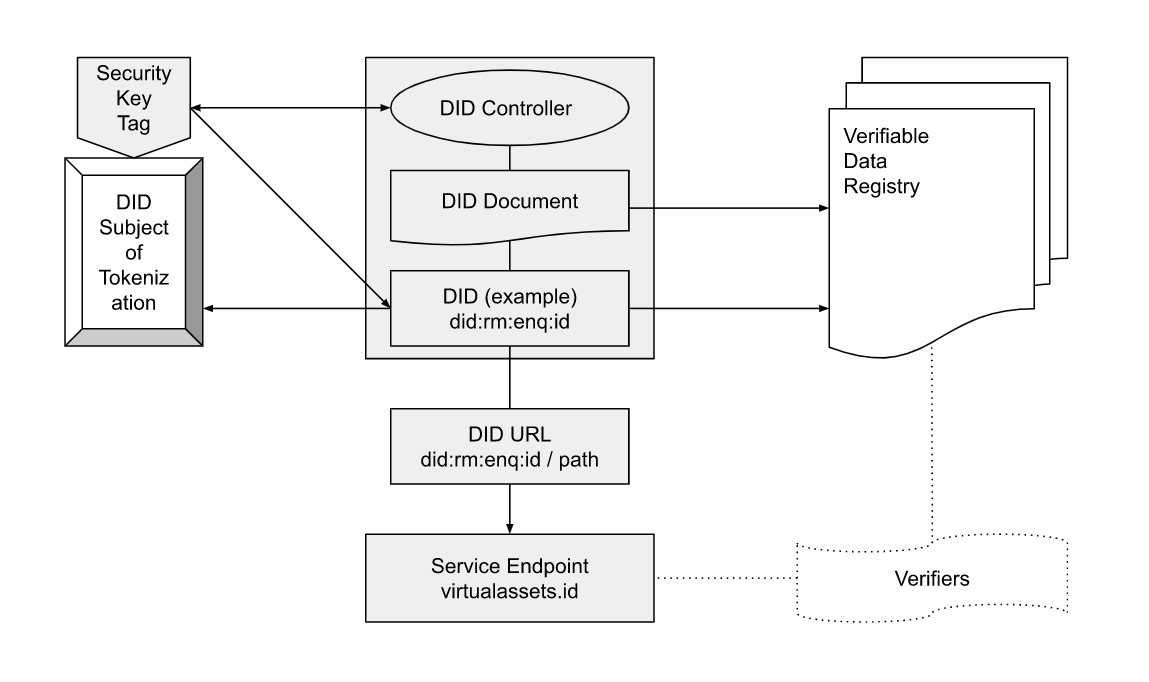
The namestring that shall identify this DID method is : rm
A DID that uses this method MUST begin with the following prefix: did:rm. Per the DID specification, this string MUST be in lowercase.
DID Format
RealMatter DID =  did: rm: method-specific-ledger-id: method-specific-subject-id
method-specific-ledger-id  =  1*idchar   where idchar = 0-9 / a-z
method-specific-subject-id =  40*idhex   where idhex  = 0-9 / a-f
This generic DID scheme is a URI scheme conformant with RFC3986
where
method-specific-ledger-id refers to the DLT ledger e.g. Enecuum ENQ pubic blockchain
method-specific-subject-id refers to a string of 40 hexadecimal characters
example :
did: rm: enq: f045c5c7d50145b65ca2702c38b4e2d46658293c
Method Specific Subject ID Generation
Take the highly secured key tag hardware as a default contract , method-specific-subject-id should be encoded as follow:
Retrieve the hardware RNG generated public key in the highly secured key tag hardware
Hash the public key and take the first 20 hex digits
Use the multibase format base16 to encode the first 20 digits without the prefix letter of base16 identifier to obtain the method-specific-subject-id in 40 hexadecimal characters.
     {
        "@context": [
          "https://www.w3.org/ns/did/v1",
          "https://w3c-ccg.github.io/ld-cryptosuite-registry/#ecdsasecp256k1signature2019"
        ],
        "id": "did:rm:enq:f045c5c7d50145b65ca2702c38b4e2d46658293c",
        "verificationMethod": [
          {
            "id": "did:rm:enq:f045c5c7d50145b65ca2702c38b4e2d46658293c#masterkey",
            "type": "EcdsaSecp256k1VerificationKey2019",
            "controller": "did:rm:enq:f045c5c7d50145b65ca2702c38b4e2d46658293c",
            "publicKeyMultibase": "fef2823c7d237bd094d633a1765d5896b0f442481a997da2f83d7a928ddce7e65",
            "blockchainAccountId":"enq:f045c5c7d50145b65ca2702c38b4e2d46658293c"
          }
        ],
        "authentication": [
          "did:rm:enq:f045c5c7d50145b65ca2702c38b4e2d46658293c#masterkey"
        ],
        "assertionMethod": [
          "did:rm:enq:f045c5c7d50145b65ca2702c38b4e2d46658293c#masterkey"
        ],
        "service": [
          {
	    "id": "did:rm:enq:f045c5c7d50145b65ca2702c38b4e2d46658293c#service",
    	    "type": "LinkedDomains",
    	    "serviceEndpoint": "https://virtualassets.id"
          }
        ]
      }
Path
One type of path is supported in this version
/contract : response = smart contract information, e.g. brief description of contract
Query
No query is supported in this version
Fragment
One type of fragment is supported in this version #masterkey : the specific master key applied in the verification methods
The instruction to create a new DID is issued via a POST HTTP request.
POST /document/did:rm:enq:f045c5c7d50145b65ca2702c38b4e2d46658293c
HTTP/1.1
Host: virtualassets.id
Content-Type: application/ld+json, application/json, text/plain, */*
Accept-Encoding: gzip, deflate
{
    "id": "did:rm:enq:f045c5c7d50145b65ca2702c38b4e2d46658293c",
    "operation": "create",
    "document": {
        "@context": [
            "https://www.w3.org/ns/did/v1",
            "https://w3c-ccg.github.io/ld-cryptosuite-registry/#ecdsasecp256k1signature2019"
        ],
        "id": "did:rm:enq:f045c5c7d50145b65ca2702c38b4e2d46658293c",
        "verificationMethod": [
          {
            "id": "did:rm:enq:f045c5c7d50145b65ca2702c38b4e2d46658293c#masterkey",
            "type": "EcdsaSecp256k1VerificationKey2019",
            "controller": "did:rm:enq:f045c5c7d50145b65ca2702c38b4e2d46658293c",
            "publicKeyMultibase": "fef2823c7d237bd094d633a1765d5896b0f442481a997da2f83d7a928ddce7e65",
            "blockchainAccountId":"enq:f045c5c7d50145b65ca2702c38b4e2d46658293c"
          }
        ],
        "authentication": [
          "did:rm:enq:f045c5c7d50145b65ca2702c38b4e2d46658293c#masterkey"
        ],
        "assertionMethod": [
          "did:rm:enq:f045c5c7d50145b65ca2702c38b4e2d46658293c#masterkey"
        ],
        "service": [
          {
	    "id": "did:rm:enq:f045c5c7d50145b65ca2702c38b4e2d46658293c#service",
    	    "type": "LinkedDomains",
    	    "serviceEndpoint": "https://virtualassets.id"
          }
        ]
    }
}
The instruction to read a DID is issued via a GET HTTP request.
https://virtualassets.id/{method-specific-subject-id}
Example :
https://virtualassets.id/f045c5c7d50145b65ca2702c38b4e2d46658293c
GET /document/did:rm:enq:f045c5c7d50145b65ca2702c38b4e2d46658293c
HTTP/1.1
Host: virtualassets.id
Content-Type: application/ld+json, application/ld+json, application/json, text/plain,
Accept-Encoding: gzip, deflate
Response from the service endpoint did.artrac.id
{
    "responseCode": 0,
    "id": "did:rm:enq:f045c5c7d50145b65ca2702c38b4e2d46658293c",
    "document": {
        "@context": [
            "https://www.w3.org/ns/did/v1",
            "https://w3c-ccg.github.io/ld-cryptosuite-registry/#ecdsasecp256k1signature2019"
        ],
        "id": "did:rm:enq:f045c5c7d50145b65ca2702c38b4e2d46658293c",
        "verificationMethod": [
          {
            "id": "did:rm:enq:f045c5c7d50145b65ca2702c38b4e2d46658293c#masterkey",
            "type": "EcdsaSecp256k1VerificationKey2019",
            "controller": "did:rm:enq:f045c5c7d50145b65ca2702c38b4e2d46658293c",
            "publicKeyMultibase": "fef2823c7d237bd094d633a1765d5896b0f442481a997da2f83d7a928ddce7e65",
            "blockchainAccountId":"enq:f045c5c7d50145b65ca2702c38b4e2d46658293c"
          }
        ],
        "authentication": [
          "did:rm:enq:f045c5c7d50145b65ca2702c38b4e2d46658293c#masterkey"
        ],
        "assertionMethod": [
          "did:rm:enq:f045c5c7d50145b65ca2702c38b4e2d46658293c#masterkey"
        ],
        "service": [
          {
	    "id": "did:art:enq:f045c5c7d50145b65ca2702c38b4e2d46658293c#service",
    	    "type": "LinkedDomains",
    	    "serviceEndpoint": "https://virtualassets.id"
          }
        ]
    }
}
The instruction to update a DID is issued via a PUT HTTP request.
PUT /document/did:rm:enq:f045c5c7d50145b65ca2702c38b4e2d46658293c
HTTP/1.1
Host: virtualassets.id
Content-Type: application/ld+json, application/json, text/plain
Accept-Encoding: gzip, deflate
{
    "id": "did:rm:enq:f045c5c7d50145b65ca2702c38b4e2d46658293c",
    "operation": "update",
    "document": {
        "@context": [
            "https://www.w3.org/ns/did/v1",
            "https://w3c-ccg.github.io/ld-cryptosuite-registry/#ecdsasecp256k1signature2019"
        ],
        "id": "did:rm:enq:f045c5c7d50145b65ca2702c38b4e2d46658293c",
        "verificationMethod": [
          {
            "id": "did:rm:enq:f045c5c7d50145b65ca2702c38b4e2d46658293c#masterkey",
            "type": "EcdsaSecp256k1VerificationKey2019",
            "controller": "did:rm:enq:f045c5c7d50145b65ca2702c38b4e2d46658293c",
            "publicKeyMultibase": "fef2823c7d237bd094d633a1765d5896b0f442481a997da2f83d7a928ddce7e65",
            "blockchainAccountId":"enq:f045c5c7d50145b65ca2702c38b4e2d46658293c"
          }
        ],
        "authentication": [
          "did:rm:enq:f045c5c7d50145b65ca2702c38b4e2d46658293c#masterkey"
        ],
        "assertionMethod": [
          "did:rm:enq:f045c5c7d50145b65ca2702c38b4e2d46658293c#masterkey"
        ],
        "service": [
          {
	    "id": "did:rm:enq:f045c5c7d50145b65ca2702c38b4e2d46658293c#service",
    	    "type": "LinkedDomains",
    	    "serviceEndpoint": "https://virtualassets.id"
          }
        ]
    }
}
The instruction to delete a DID is issued via a DELETE HTTP request.
DELETE https://virtualassets.id/f045c5c7d50145b65ca2702c38b4e2d46658293c
The DID:RM method never exposes the private key. The user can however use and display the DID's private key locally on the highly secured security key tag hardware.
In the RealMatter DID system, all users' private data is stored on the highly secured security key tag hardware. Only the hash value or strings generated by crypt algorithms of the data are public on-chain, the attackers cannot derive the private data with the hash value or strings.
All data stored in DID documents is considered public. DID documents do not contain any personal information about the user concerned.
Attacks
To prevent an attack, a did proof has to go through the signature verification against the verifier’s challenge. The signature is processed inside the highly secured security key tag hardware.
The RealMatter DID blockchain and DID Documents contain no PII (Personally-Identifiable Information).
Private data in RealMatter is encrypted and signed using the private key which corresponds to the public key in the DID. This ensures that no message insertion or modification is possible and authenticity of the DID Documents is ensured.
The RealMatter DID system prevents forgery and tampering through hash value checking.
Private keys(for signing operations) are to be held on highly secured security key tag hardware.